Every year, cross-border traders in Africa lose approximately $5 billion to currency conversion hurdles. For a local manufacturer or agricultural exporter, this is not just a statistical anomaly, it is capital that could be reinvested in growth, staff, or infrastructure. The African Continental Free Trade Area (AfCFTA) is shifting from high-level policy negotiation to the practical “heavy lift” of implementation. Central to this transition is the Pan-African Payment and Settlement System (PAPSS), a digital tool designed to ensure that when you trade across borders, your profit margin stays with you, rather than being eroded by third-party currency exchanges.
In this second part of our four-part AfCFTA explainer series, we look at the financial tools that can change your bottom line. We’ll be breaking down how PAPSS and digital trade protocols can help you reclaim trade margins and cut operational costs.
What is PAPSS?
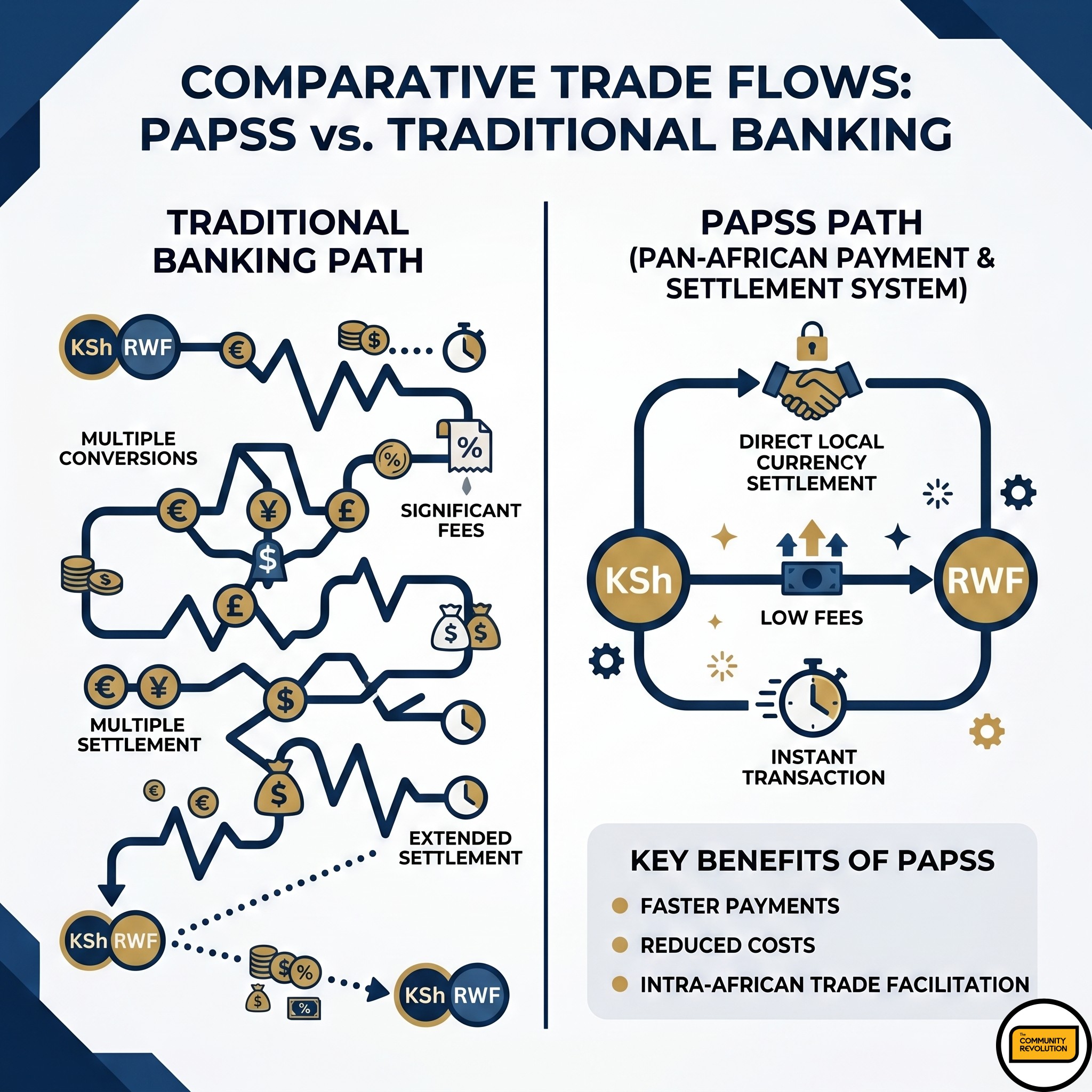
The Pan-African Payment and Settlement System (PAPSS) is a centralised financial market infrastructure established by the African Export-Import Bank (Afreximbank) and the AfCFTA Secretariat. Unlike the traditional “correspondent banking” model, where money often leaves the continent to be converted into USD or EUR before reaching its destination, PAPSS processes transactions in local African currencies.
- Who: Designed for African businesses, from small cross-border traders to large manufacturers.
- What: A digital payment settlement system that enables instant, secure transactions between different African currencies.
- Where: Across all participating AfCFTA member states, with a focus on established trade corridors.
- When: The system is currently live and scaling rapidly across the continent.
- Why: To bypass the “hidden tax” of forex conversion, which currently drains $5 billion from the African economy every year.
- How: By integrating your local bank or payment provider into the PAPSS network, allowing your business to pay suppliers and receive funds in your own domestic currency.
The hidden tax on your business
If you are an MSME owner operating on the African continent (e.g. Ghana, Tanzania, Kenya, Rwanda, The Gambia, Namibia etc), the complexity of cross-border trade has historically acted as a barrier to scaling. The current reliance on international, non-African currencies for intra-continental trade creates a “hidden tax” on every transaction. When you move goods across borders, fluctuating exchange rates, wire transfer delays, and banking fees act as a constant drag on your net profit. The AfCFTA Secretariat has explicitly identified the mitigation of this financial friction as a priority for industrialisation. It is no longer acceptable for small businesses to sacrifice a significant portion of their revenue to antiquated financial systems.
Practical steps: how to trade smarter with PAPSS
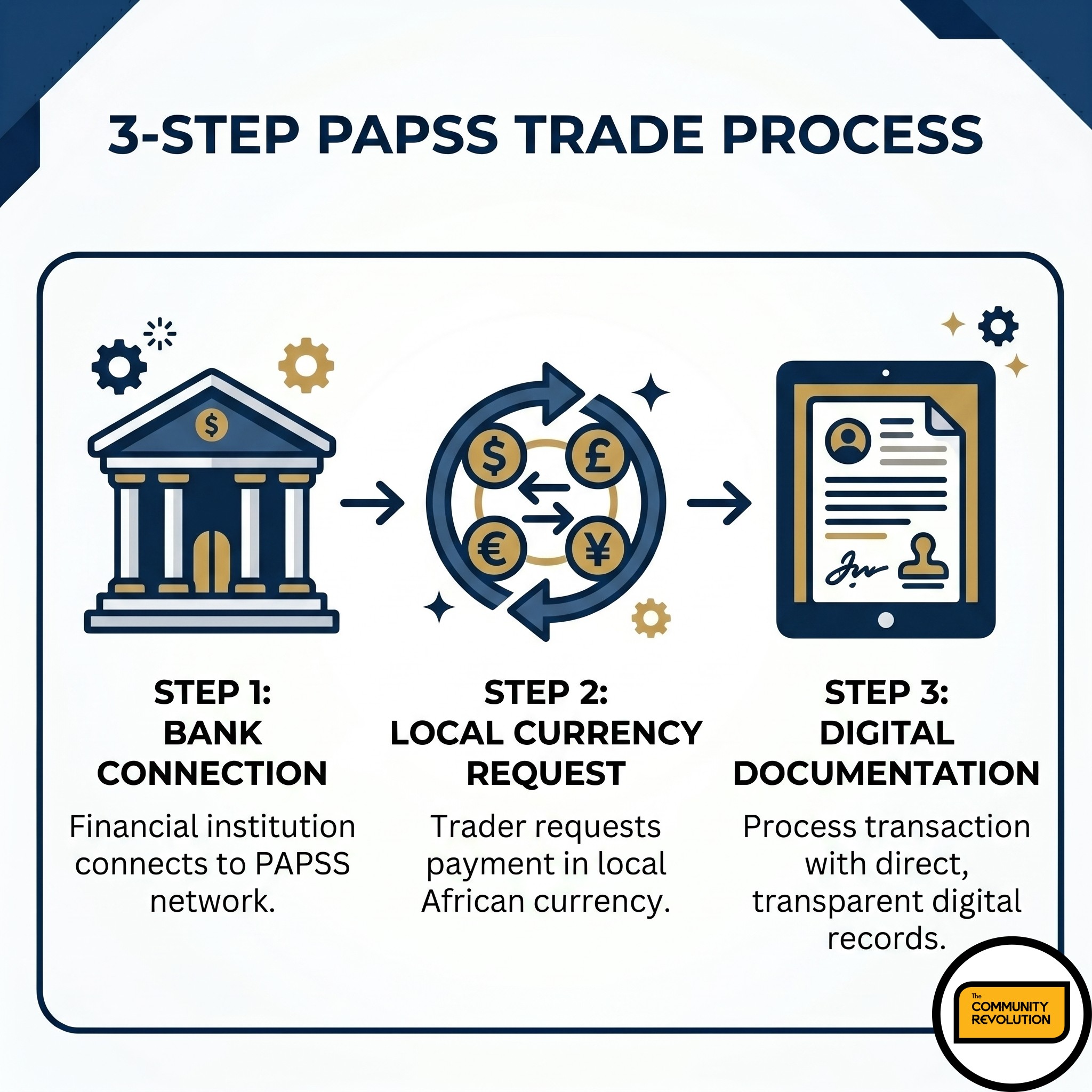
Now that you understand the financial impact of current cross-border payment barriers, the next step is operationalising these tools. Transitioning to a digital-first approach with PAPSS is more straightforward than many business owners realise. Follow these three steps to begin reclaiming your trade margins:
- Verify your bank’s connectivity: PAPSS operates through your existing commercial bank network. Start by contacting your account manager or checking your bank’s corporate portal to confirm they are connected to the PAPSS network.
- Request local currency settlement: When you are initiating a transaction with a supplier in another African country, explicitly request that the payment be settled in local currency via the PAPSS corridor. This simple instruction is the primary mechanism for bypassing the need to convert funds into third-party currencies, effectively neutralising the “hidden tax” of exchange rate fluctuations.
- Align your digital documentation: To maximise the speed and efficiency of your payments, ensure your trade documentation (such as invoices and digital IDs) is digitised. When your e-invoicing matches your digital payment instructions, your transaction is less likely to face manual reconciliation delays, allowing for almost instant settlement.
For real-time updates on which trade corridors are currently supported and to receive a roadmap for implementing these protocols, we invite you to join our upcoming MSME Day Webinar on 25 June.
The TCR mandate: Bridging the digital divide
At The Community Revolution, we recognise that these digital systems are only as effective as the people who can use them. Drawing on insights from our recent research into Tanzania value-chains, we understand that efficiency in “digital value chains” relies on three pillars: infrastructure, literacy, and accessible solutions.
Our digital capability programme is designed to bridge this exact gap. We help entrepreneurs understand that the AfCFTA digital tools, such as PAPSS and the digitised Rules of Origin, are the “operating system” of the new African market. Just as we have observed in our PURE (Productive Use of Renewable Energy) initiatives, where digital-first design removes logistical bottlenecks, these financial tools remove trade bottlenecks. We are here to ensure that you have the digital literacy and infrastructure to interact with these systems confidently, moving from raw production to processed, high-value exports without the fear of margin erosion.

Key terms and concepts
AfCFTA (African Continental Free Trade Area)
The African Continental Free Trade Area (AfCFTA) is a landmark agreement that establishes a single, unified market for goods and services across the continent. By harmonising trade policies and removing barriers, it aims to boost intra-African trade, foster industrialisation, and empower businesses of all sizes to scale confidently across borders.
PAPSS (Pan-African Payment and Settlement System)
The Pan-African Payment and Settlement System (PAPSS) is the digital financial infrastructure powering the next phase of African trade. It enables instant, secure payments in local currencies, eliminating the historical need for businesses to convert funds into expensive foreign “hard” currencies. By removing these conversion hurdles, PAPSS helps you reduce transaction fees, minimise financial risk, and keep more of your hard-earned profit within your business.
Forex loss
Forex loss occurs when businesses are forced to convert local earnings into foreign currencies (such as USD or EUR) to pay for cross-border goods or services. This process often incurs high intermediary bank fees and unfavourable exchange rates, eating into your trade margins. PAPSS mitigates this by allowing you to pay suppliers directly in your local currency.
Digital trade
Digital trade refers to the use of digital tools and protocols, such as e-invoicing, digital IDs, and automated payment systems, to conduct business. It replaces traditional, manual paperwork with streamlined electronic processes, making trade faster, more transparent, and significantly less prone to error or delay.
Conclusion: A competitive future
Mastering these financial tools, from leveraging PAPSS to adopting digital trade protocols, is your decisive step toward reclaiming your margins and ensuring your business thrives within the AfCFTA. By actively mitigating forex loss and simplifying your cross-border operations, you aren’t just cutting costs; you are building a future-proof enterprise ready to compete on a continental scale.
But the journey doesn’t stop here. Join us for our MSME Day Webinar on 25 June, where we will translate these concepts into a concrete roadmap for your business. This is your opportunity to engage with trade experts, get your specific questions answered, and connect with a community dedicated to your growth. Secure your spot today and take the next step in your AfCFTA journey.
About this series
This article is the second in our four-part AfCFTA Explainer Series, designed to guide you through the transition from policy negotiation to practical implementation. Join us as we explore the tools and protocols essential for your business, culminating in our MSME Day Webinar on 25 June 2026.
What’s coming next:
- Article 3: Your QR code to trade – A practical guide to mastering digital compliance and clearing border hurdles.
- Article 4: Access to prosperity – An exploration of why AfCFTA inclusion protocols are a vital catalyst for women, youth, and agribusiness.